This study analyses the most prominent cryptocurrency scams from 2022 to 2024, highlighting certain trends and common manipulation tactics used by fraudsters during this period. The paper builds upon a previous study that examined the most prominent scams during the Covid-19 pandemic, between 2020 and 2022, a period characterised by substantial market volatility and heightened investor interest. In contrast, the period from 2022 to 2024 was marked by a bear market, during which investor interest in cryptocurrency declined. Despite this downturn, several significant scams emerged, which are analysed here.
The findings reveal a significant reported financial loss, highlighting investors' vulnerabilities. The paper does a comparison analysis per year on the type of scams, monetary losses, the founding country of the scams, the number of users affected, and arrests made. By examining the financial impact of these scams, the study aims to provide insight into the scale and severity of fraud in the cryptocurrency market during this period, and to inform policymakers, industry stakeholders, and researchers about the pressing challenges in securing the cryptocurrency ecosystem.
Introduction and Background
The digital society has proven to be vulnerable in different ways, and many of these vulnerabilities manifest only once something intangible or tangible is misused or destroyed. One such vulnerable area is the financial markets, especially in the realm of cryptocurrencies. These rapidly growing cryptocurrency markets have in recent years not only attracted a wave of new investors but have also created fertile ground for fraudulent activities. Many individuals in this new terrain find both valid and false information on cryptocurrencies, making it challenging to verify facts. Further, as generative Artificial Intelligence continues to improve, microtargeting and personalisation of digital content become easily accessible to the masses. As digital assets gain mainstream acceptance, the allure of high returns has drawn many individuals into a complex and often opaque financial landscape — an environment that has also given rise to an alarming increase in cryptocurrency scams, exploiting investor naivety and market volatility.
A previous study by the authors focused on analysing crypto scams during the Covid-19 pandemic from 2020 to August 2022. That study's findings indicated financial losses due to scams amounted to approximately $5.7 billion in 2020, increased to $6.2 billion in 2021, and declined significantly to nearly $500 million in 2022. The US Federal Trade Commission (FTC) reported that in May 2021 the number of crypto scams was twelve times higher than in 2020. Although 2022 recorded the lowest financial losses during that earlier period, it experienced the highest number of reported scams — by August 2022, the total number of detected scams had already surpassed the total reported in 2021.
This study builds upon that earlier research and aims to provide a comprehensive analysis of the various types of scams that emerged between 2022 and October 2024 (the time of writing), specifically examining Ponzi schemes, rug pulls, fraudulent mining operations, deceptive cryptocurrency projects, fake investment schemes, and misleading trading platforms.
Objectives
This study focuses specifically on scams, excluding blockchain hacks and exploits, as these involve distinct mechanisms and operational dynamics. Through an analysis of the most significant cryptocurrency scams, based on the largest financial losses, the primary objective of this study is to emphasise the critical need for enhanced public education and awareness. The research identifies distinct trends and tactics employed by fraudsters, shedding light on the evolving methods of manipulation and the growing need for vigilance among investors. Additionally, the study emphasises the necessity for stronger regulatory interventions to address the evolving landscape of cryptocurrency fraud, and highlights the effectiveness of existing regulatory responses, where applicable.
Methodology
The authors categorise prevalent scams based on both qualitative and quantitative characteristics. Qualitative characteristics include the type of scam (e.g., Ponzi schemes, rug pulls) and trends and manipulation tactics (such as phishing), while quantitative characteristics encompass monetary losses, the number of users affected, and similar metrics. By examining the evolving trends in scams, the researchers aim to provide valuable insights that can raise awareness of these fraudulent activities and, ultimately, safeguard investors and promote a more secure cryptocurrency ecosystem.
Top Cryptocurrency Scams from 2022 to 2024
In 2022, several high-profile cryptocurrency scams and fraudulent schemes emerged, targeting investors and exploiting vulnerabilities within the rapidly expanding digital asset sector. In 2023, the cryptocurrency market remained a focal point for fraudulent activities, driven by its decentralised nature, lack of regulatory oversight, and the anonymity it affords. By 2024, while cryptocurrency scams continued to evolve, their financial impact was comparatively smaller, resulting in monetary losses that were not significant enough to warrant inclusion in this study. The table below presents a selection of the most significant cryptocurrency scams, ranked based on monetary losses, from 2022 to October 2024. Notably, the year associated with each scam does not correspond to the period during which it was initiated or actively operated, but rather to the year in which it was officially recognised as a scam.
| Rank | Name | Type | Year | Losses | Founding Country | Users Affected | Arrests Made |
|---|---|---|---|---|---|---|---|
| 1 | Terra Luna | Fake Crypto Project | 2022 | $40 billion | South Korea | Unknown | Yes |
| 2 | FTX & Alameda Research | Fake Exchange | 2022 | $8 billion | USA | Unknown | Yes |
| 3 | Celsius Network Collapse | Fake Investment | 2022 | $4.7 billion | USA | 1.7 million | Yes |
| 4 | Thodex | Fake Exchange | 2023 | $2.6 billion | Turkey | 390 thousand | Yes |
| 5 | BitConnect | Fake Investment / Ponzi Scheme | 2022 | $2.4 billion | USA | 800 | Yes |
| 6 | HyperFund | Fake Mining / Fake Investment | 2022 | $1.89 billion | Australia / USA | Unknown | Under investigation |
| 7 | BitClub Network | Fake Mining / Ponzi Scheme | 2022 | $722 million | USA | Unknown | Under investigation |
| 8 | HashFlare & Polybius Bank | Fake Investment / Ponzi Scheme / Fake Mining | 2022 | $575 million | Estonia | Hundreds of thousands | Under investigation |
| 9 | Forsage | Ponzi Scheme | 2023 | $340 million | Russia | Unknown | Under investigation |
| 10 | EmpiresX | Ponzi Scheme | 2022 | $100 million | USA – Florida | Unknown | Yes |
| 11 | Mining Capital Coin | Fake Mining | 2022 | $62 million | USA – Florida | Unknown | Yes |
| 12 | Squid Game Token | Rug Pull / Ponzi Scheme | 2022 | $3.3 million | Unknown | Unknown | No / Unknown |
| 13 | Frosties NFT | Rug Pull | 2022 | $1.1 million | USA | Unknown | Yes |
In May 2022, the Terra LUNA blockchain, along with its algorithmic stablecoin, TerraUSD (UST), and its associated token, LUNA, collapsed. The stablecoin lost its peg to the US dollar, and the value of LUNA plummeted by more than 99%. An estimated $40 billion in market value was erased, affecting millions of investors. Subsequent investigations suggested that Terra's co-founder, Do Kwon, may have misled investors concerning the stability of both UST and LUNA.
In November 2022, FTX, one of the largest cryptocurrency exchanges globally, filed for bankruptcy following a liquidity crisis that exposed significant mismanagement of user funds. Investigations later revealed that FTX's CEO, Sam Bankman-Fried (commonly referred to as SBF), along with key executives, had diverted billions of dollars in user assets to its affiliated hedge fund, Alameda Research. Over $8 billion in customer funds were misappropriated, resulting in one of the most significant scandals in cryptocurrency history, with many users losing their entire holdings.
In July 2022, the cryptocurrency lending platform Celsius Network suspended withdrawals and subsequently filed for bankruptcy. Investigations revealed that the company, led by CEO Alex Mashinsky, had engaged in risky trading practices and mismanaged customer deposits. Celsius held approximately $4.7 billion in customer deposits and had over 1.7 million users. The bankruptcy resulted in significant financial losses for users who had entrusted their funds to Celsius, many of whom were small retail investors.
In 2021, Faruk Fatih Ozer, the founder of the cryptocurrency exchange Thodex (based in Turkey), fled to Albania with investor assets following the platform's collapse. The incident resulted in financial losses amounting to $2.6 billion, affecting 2,027 victims. Bitconnect was a fraudulent investment platform that operated with its own digital token, BitConnect Coin (BCC), promising guaranteed monthly returns of 40% through a custom trading bot and software. Similarly, HyperFund was a deceptive cryptocurrency mining and investment platform that defrauded investors of approximately $1.89 billion — operating under various aliases, including HyperCapital, HyperTech, HyperNation, and HyperVerse, and promising daily returns ranging from 0.5% to 1%. BitClub Network was a fraudulent investment platform where investors were encouraged to purchase shares in three purported mining pools, claiming investors would earn a portion of the cryptocurrency mined by the network, with a Ponzi scheme incorporated into the platform promising rewards to individuals who recruited new users.
Hashflare and Polybius Bank were two fraudulent operations orchestrated by founders Sergei Potapenko and Ivan Turogin from Estonia. In 2022, both individuals were indicted for defrauding over $575 million from hundreds of thousands of victims worldwide, operating a Ponzi scheme alongside a fictitious crypto-mining operation. Forsage was a decentralised finance (DeFi) cryptocurrency platform operating on the Ethereum, Binance, and Tron blockchains, using smart contracts to promote itself as a secure and profitable investment opportunity — ultimately revealed to be a Ponzi scheme involving DeFi fraud, resulting in $340 million in losses. EmpiresX was a global cryptocurrency Ponzi scheme that accumulated approximately $100 million from investors, promising a daily profit of 1% via a claimed AI-powered bot supported by a licensed trader — the trading bot was revealed to be fraudulent, manual trades indicated significant losses, and investors' funds were misappropriated for personal use.
Mining Capital Coin (MCC) was a fraudulent investment and mining platform promising guaranteed daily returns of 1% profit, with its Royal package promising a weekly payout of $84,000 and a 10% commission offered through a Ponzi scheme for recruiting new investors. MCC defrauded investors of $62 million; payouts were purportedly made through their fake trading platform, Bitchain, and withdrawals could only be processed in their proprietary token, Capital Coin (CPTL) — users encountered errors when attempting to exchange their tokens on the platform. Capitalising on the popularity of Netflix's Squid Game, scammers launched the Squid Game (SQUID) token in late 2021, widely recognised as a scam by early 2022 — the token initially surged in value before the developers executed a "rug pull," absconding with the funds, with investors losing approximately $3.3 million. In early 2022, the developers of the Frosties NFT project abandoned the initiative after raising $1.1 million from investors, in an event commonly referred to as a rug pull — the project had promised a variety of rewards and future developments, none of which materialised.
Analysing Trends and Tactics
This section presents an analysis of the most significant cryptocurrency scams, as outlined in Table 1, based on key factors such as scam type, year of occurrence, monetary losses, country of origin, number of affected users, and whether any arrests have been made.
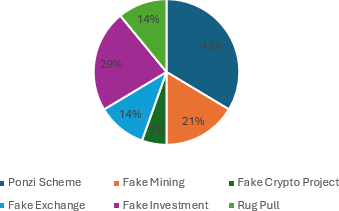
Ponzi schemes are the most prevalent scam type identified in the analysis, accounting for 43% of the most significant recorded cases. The second most common scam type is fraudulent investment schemes, comprising 29% of documented scams. Fake mining operations also represent a notable trend, making up 21% of cases. In contrast, fraudulent cryptocurrency projects constitute only 7% of the top scams. Additionally, both fake exchanges and rug pulls each account for 14% of the recorded scams (these percentages sum to more than 100% because several scams — for example BitConnect and HashFlare — were classified under more than one type).
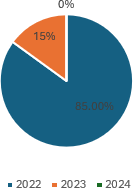
The majority of the most significant scams (85%) occurred in 2022, while only 15% took place in 2023, and none were recorded in 2024. Although scams continued to emerge in 2024, none were as significant as those in previous years. A noticeable decline in major scams from 2022 to October 2024 suggests a potential correlation with the ongoing bear market since 2022, which may have reduced overall interest and investment in cryptocurrencies, thereby limiting opportunities for large-scale fraudulent schemes. In 2024, the cryptocurrency market transitioned into a bull phase, which is expected to attract increased investor interest in the coming years — this renewed enthusiasm may potentially lead to a rise in significant scams and financial losses.
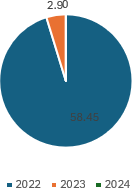
As illustrated in Figure 3, investors in 2022 experienced substantial monetary losses totalling $58.45 billion. However, in 2023, there was a significant decline in total losses, with only $2.9 billion recorded. No notable losses were reported in 2024, likely due to the prevailing bear market, which may have reduced investor participation and, consequently, the scale of fraudulent activities.
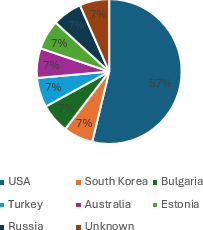
The distribution of scams per country shows that the majority between 2022 and 2024 originated in the United States, accounting for 57% of the most significant cases. In contrast, all other listed countries — South Korea, Bulgaria, Turkey, Australia, Estonia, and Russia — each collectively accounted for only 7% of the top scams.
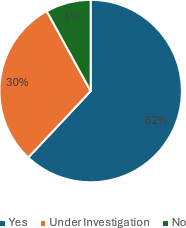
Arrests were made in 62% of the documented scams, while 30% remain under active investigation. In 8% of the cases, either no arrests were made or there is insufficient information regarding any legal action taken.
In 2023, there was a significant decline in the value received by illicit cryptocurrency addresses — the total share of illicit activity dropped from 0.42% in 2022 to 0.34% in 2023. A notable shift in tactics was observed in the types of cryptocurrencies involved in criminal activities and scams, with stablecoins emerging as the preferred currency, replacing Bitcoin, which had been the dominant currency in the previous two years. However, Bitcoin continues to be predominantly used in darknet markets and ransomware extortion activities.
In 2024, there have been no significant scams in terms of monetary losses, likely due to the ongoing bear market. Scammers appear to have shifted from broad-based Ponzi schemes to more targeted tactics, such as pig butchering, work-from-home scams, romance scams, drainers, and address poisoning. These scams often involve scammers building relationships with their victims to lure them into fraudulent investment opportunities, rather than relying on widespread advertising. On-chain metrics from Chainalysis indicate that scamming revenues have been trending downward globally over the past three years — it is believed that scamming tends to be more successful in bull markets, where the fear of missing out on "get rich quick" opportunities creates a more fertile environment for fraud.
Regulatory Responses
Most significant cases have resulted in arrests or remain under investigation. This section provides a detailed account of each case, focusing on the regulatory responses and legal actions taken, in the same ranking order as Table 1.
Several lawsuits were filed against the Terra LUNA platform, and regulators initiated investigations into the platform's operations. The CEO, Do Kwon, was arrested in Montenegro, Southeast Europe, in March 2023. The SEC was anticipated to impose a $5.3 billion penalty to settle the case. The CEO of FTX, Sam Bankman-Fried, was indicted by the US District Court on eight criminal charges, including money laundering, wire fraud, campaign finance violations, and securities fraud. SBF was released from custody on a $250 million bond — the largest bond in history — and was subsequently sentenced to 25 years in federal prison, also being ordered to pay more than $11 billion in forfeiture.
The CEO of Celsius Network, Alex Mashinsky, was charged with defrauding tens of thousands of customers by promising unrealistic returns on investments, and was released on a $40 million bail. The founder of Thodex was sentenced to 11,196 years in prison in Turkey for money laundering, fraud, and organised crime. Bitconnect's founder, Satish Kumbhani, was indicted for orchestrating a global Ponzi scheme — if convicted, he faces a potential 70-year prison sentence on charges of wire fraud, commodity price manipulation, international money laundering, and operating an unlicensed money-transmitting business. A federal judge also ordered Kumbhani to pay $17.6 million in restitution to approximately 800 victims from over 40 countries.
Three suspects were charged in connection with the HyperFund scam, though the case remains under investigation. The main founder, Sam Lee from Australia, faces a potential five-year sentence if convicted of charges related to conspiracy to commit wire and securities fraud. Brenda Chunga, from Maryland, USA, pleaded guilty to being a co-conspirator and promoter of the scheme and also faces a five-year sentence if convicted. Rodney Burton, from Florida, USA, was also charged with promoting the scheme.
As of October 2024, the BitClub Network case remains under investigation, though the founders have pleaded guilty to charges of wire fraud, money laundering, and conspiracy to sell unregistered securities. The founders of Hashflare and Polybius Bank were arrested in Estonia and charged with 16 counts of wire fraud, along with two additional counts of conspiracy to commit wire fraud and money laundering — if convicted, they face a maximum sentence of 20 years in prison. In February 2023, Forsage was indicted for operating a global Ponzi scheme, with founders Vladimir Okhotnikov, Olena Oblamska, Mikhail Sergeev, and Sergei Maslakov each facing a potential 20-year prison sentence if convicted.
In 2022, the head trader of EmpiresX pleaded guilty to conspiracy to commit securities fraud. In 2023 he was sentenced to 51 months in prison, followed by three years of supervised release, and was ordered to pay $3,379,527 in restitution. The founder of Mining Capital Coin was charged with conspiracy to commit securities fraud, wire fraud, and international money laundering — as of the time of writing, the case remains under investigation. No information could be found on arrests or legal charges for the Squid Game (SQUID) Token. Two individuals involved in the Frosties NFT rug pull have been arrested and formally charged with conspiracy to commit wire fraud and conspiracy to commit money laundering — if convicted, they each face a maximum sentence of 20 years in prison.
Overall, regulatory responses have been effective in addressing these larger and more significant scams, with authorities taking legal action against key perpetrators. However, smaller cases, not listed in this study, have not received the same level of attention, often resulting in limited enforcement and fewer legal consequences.
Conclusion
This paper examined some of the most significant cryptocurrency scams, based on monetary losses, that occurred between 2022 and 2024. The findings reveal notable trends in fraudulent activities within the cryptocurrency market. In 2022, a substantial increase in fraud was observed, likely influenced by the rapid digital adoption following Covid-19. However, 2023 saw a decline in the number of significant scams, and by 2024, no major scams in terms of monetary losses were recorded. Several factors may explain this trend: the analysis was conducted before the end of 2024, so a comprehensive assessment of that year's fraudulent activities was not yet possible; there appears to be a shift in scam tactics, likely due to increased awareness and the maturing cryptocurrency ecosystem; and the prevailing bear market conditions may have contributed to reduced investor enthusiasm, making large-scale scams less viable.
Comments (0)