As deepfakes and scams online become more common, many individuals, organisations and nation-states struggle to maintain trust and remain credible sources for their stakeholders. Increasingly, algorithms shape the digital information landscape, choosing what content is displayed and deepening the individual silos of information seeking. Recently it has been suggested that the best efforts to combat misinformation are not to try to stop its spread, but through understanding the vulnerabilities on which it lands in the individual receiving the false information. There is an urgent need to investigate the mechanisms and extent of deception in online environments, as little is known about the specific vulnerabilities that cause individuals to become victims of online scams.
This paper starts by categorising the different levels on which digital communication may be vulnerable. Further, it asks how these vulnerabilities are utilised and what persuasion tactics are at use when crypto scams are concerned. Building on the persuasion principles of Robert Cialdini, this paper analyses three recent, highly successful online crypto scams. The findings conclude that social proof and scarcity were the most used influence mechanisms across all three, suggesting that scam prevention needs to focus on understanding the vulnerabilities on which these influence mechanisms build.
Introduction
New AI technologies of the post-truth era enable the creation of increasingly convincing fake and false content. As nations and institutions are unable to control the spread of either true or false information online, vulnerability to digital scams and propaganda is increasing. Such lack of control causes fragility, reduces collaboration, and deepens information vacuums of lacking or missing information. Recent research suggests that central to the success of scams are individual-level vulnerabilities: how individuals evaluate the credibility of influence attempts, and what digital vulnerabilities enable these.
Scams build on the ability to persuade individuals that something is real. Persuasion, understood as a process of deliberately attempting to alter another individual's or group's beliefs, views and behaviour, builds on providing its target with just enough cues to appear authentic. These mechanisms of deception, and believing something that is not authentic or real, have remained understudied despite the major financial losses caused by such hoaxes. Recent measures suggest the amount of global financial losses due to scams and fraud has been estimated at up to $485.6 billion (Nasdaq & Verafin, 2024). It is also worth noting that the majority of corporate hoax cases remain unreported due to their sensitive nature, fear of public backlash if discovered, and the high potential negative impact on brand or corporate reputation — many of these cases could have been avoided had corporations and organisations been better prepared and understood the different individual-level vulnerabilities.
In this paper the focus is on persuasion principles and analysing their role in three recent online crypto scams that fooled great numbers of people into joining: the giveaway scam, the pump-and-dump scam, and the Ponzi scheme.
New Vulnerabilities
An environment where fact and fiction combine, and the real truth is difficult to distinguish from scams, results from four societal trends: a decline in the social capital of authentic collaboration outside the internet, leaving people vulnerable as decisions are made individually and in isolation; growing economic inequality and financial challenges, which cause stress and make individuals take irrational risks; an increase in opinion strength and polarisation, making strong claims seem more natural than before; and a slow decline in trust in scientific evidence and experts, leading to a lack of understanding of the realities behind complex systems such as crypto. Add to this an increasingly fractioned media landscape without a common "public opinion" forming, where facts can be checked and myths debunked, and individuals can fall deep inside the biased thinking of their niche online communities without having to be interrupted by the truth.
Vulnerability refers to some form of reduced capacity — an actual or potential inability to fend off harm. Such vulnerabilities can take place in the physical, psychological, socioeconomic, or even social realms, and may or may not be known by the organisation or individual. These vulnerabilities occur on three different levels:
- Individual, cognitive vulnerabilities — such as cognitive biases.
- Social, public opinion vulnerabilities — the manipulability of narratives.
- Situational, system-level stress — situations of stress.
Individuals prepare for, critically analyse, and become aware only of those messages they realise to be attempts to influence them. According to the persuasion knowledge model, an influence attempt loses its power the moment an individual becomes aware of its persuasion mechanism and develops a certain reactance to it — hoaxes are planned to avoid such realisations and to keep people from developing negative reactance. What makes people convinced is often a combination of providing what they want to hear and see: believability results from the content of the message, how personally involved the individual is, and the kind of attitude they take towards a topic. An individual's emotions, as well as the perceived benefit to be gained, are also strongly important.
There are six principles of persuasion that can be utilised by scams (Cialdini, 2014), working together in combination or activated individually. These principles build on individual as well as social vulnerabilities, while situational pressures can activate and strengthen their power:
- Reciprocity: individuals feel obliged to repay favours of any sort, and like to follow the advice or recommendations of people they feel they owe something to — for example, a friend who has invested in crypto.
- Consistency and previous commitments: individuals have a need to remain aligned in their thinking and actions. For example, if they want to be considered a tech-savvy individual, crypto investments are valuable to that self-image.
- Social proof: individuals want to do what others in society are doing, and the more people appear to be involved, the more tempting it is. For example, if your neighbours are investing in crypto, there is more pressure to join the group and invest too.
- Liking: individuals respond better to messages from people they like or look up to, or see similarities with. For example, as Elon Musk is originally from Pretoria, South Africa, individuals from that region tend to like him and take his advice.
- Authority: individuals tend to obey perceived authorities, even if it goes against their personal beliefs, and trust advice from perceived experts on specific topics. For example, as the world's richest man, Elon Musk is considered an expert for advice on money and investing.
- Scarcity: individuals view opportunities as more valuable "when they are less available." A limited-time-only crypto exchange offer makes individuals act faster than they would if the offer would always remain open.
When it comes to crypto scams, individual-level vulnerabilities are often built on cognitive biases such as confirmation bias — seeing only information that confirms existing beliefs. On the social level of digital platforms and networks, an overconfidence effect and the biases caused by in-group thinking (such as the cheerleader effect) take place across many online discussion forums where crypto is discussed. Situational-level vulnerabilities, meanwhile, are often brought about by financial struggles or stress that societies undergo, making way for a negativity bias and enabling the easier belief of false information.
Recent Crypto Scams Building on Digital Vulnerabilities
Many crypto scams have circulated in recent years, causing major cryptocurrency financial losses and becoming significant issues for society. The blockchain is decentralised and relatively unregulated, and scammers often exploit this very nature of cryptocurrencies to manipulate prices, steal funds, or deceive investors. Fake news and misleading social media posts can create urgency among investors and cause panic sells or buys, which then lead to volatile price fluctuations that benefit the fraudsters. Contrary to the original purpose of web3 and its potential to strengthen societies and foster inclusion, many new blockchain technologies have turned into a mechanism for exploitation and inequality — some have suggested a new form of "crypto-colonial" extractivism, where vulnerable populations become victims of technological advancement disguised as hope for financial independence.
Crypto scams utilise weaknesses in human cognition and emotion that are difficult to regulate and defend. In each type of crypto scam, attackers make use of unique methods and persuasion tactics to lure their victims — and the anonymity in crypto transactions makes it very difficult to trace or recover lost funds, amplifying the risk for people who fall victim to these deceptive practices. Ponzi schemes, phishing attacks, fake Initial Coin Offerings (ICOs), impersonations, giveaway scams, rug pulls or exit scams, and pump-and-dumps are some of the common scam types that have cost investors huge amounts in monetary losses.
To study these vulnerabilities in practice, three different types of global crypto scams were selected for theory-driven content analysis, built on Cialdini's six principles of persuasion. The selection criteria were that each case focused on cryptocurrencies, included severe financial losses for victims, was publicly discussed in the media, had its impact verified by previous studies, and remained of continued interest where similar scams were still current.
Case 1: Giveaway Scam
The giveaway scam usually goes hand in hand with the impersonation scam type. It is a form of social engineering where the scammer attempts to deceive a potential investor into believing that some famous person is hosting a cryptocurrency giveaway. The investor is asked to send a specific amount of crypto to a given address, with the promise that the platform will give away double the amount sent. The logic scammers use to get the victim to send bitcoin is so that the platform can "verify" the wallet address and the legitimacy of the investor's account. It should be noted that exchanges do host legitimate giveaways from time to time as marketing campaigns — but a legitimate exchange would never ask participants to send crypto to receive one.
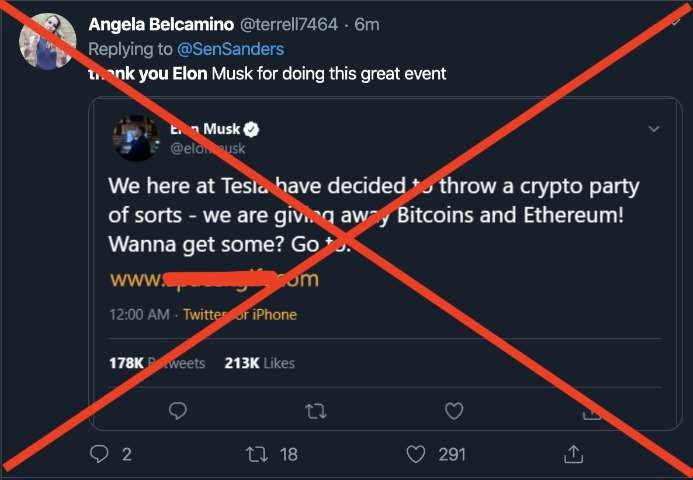
Social media sites are often used to market or announce giveaway scams. Scammers will impersonate a company, celebrity, or famous influencer, taking advantage of that person's trustworthy reputation on platforms such as Facebook, X (Twitter), YouTube, Telegram, Instagram and TikTok. Elon Musk has often been impersonated in recent years in crypto giveaway scams. The image below shows a fake tweet supposedly posted by Musk, promoting a giveaway hosted by Tesla — this is not a real tweet, but a manipulated image that never originated from Musk. The tweet contains a link that, when clicked, redirects the user to the scammer's landing page, which appears to be from Tesla or Musk, offering "free" Bitcoin and Ethereum.
Another technique scammers use is to send a direct message (DM) on social media pretending to be a celebrity or an ambassador of that celebrity, advising a potential victim to participate in the giveaway. Upon engagement, the conversation is often directed to WhatsApp, making it feel like a more personal platform and building further trust with the victim. YouTube livestreams are another popular technique: the scammer combines an older interview of a famous person with a live stream, manipulating the content to make it look like the interview is currently live, overlaid with giveaway details. The user clicks a link or QR code that redirects them to the landing page below. In addition, the scammer makes use of chatbots displaying chats of multiple users next to the video, giving the sense that many people are watching and actively participating — tapping directly into the principle of social proof.
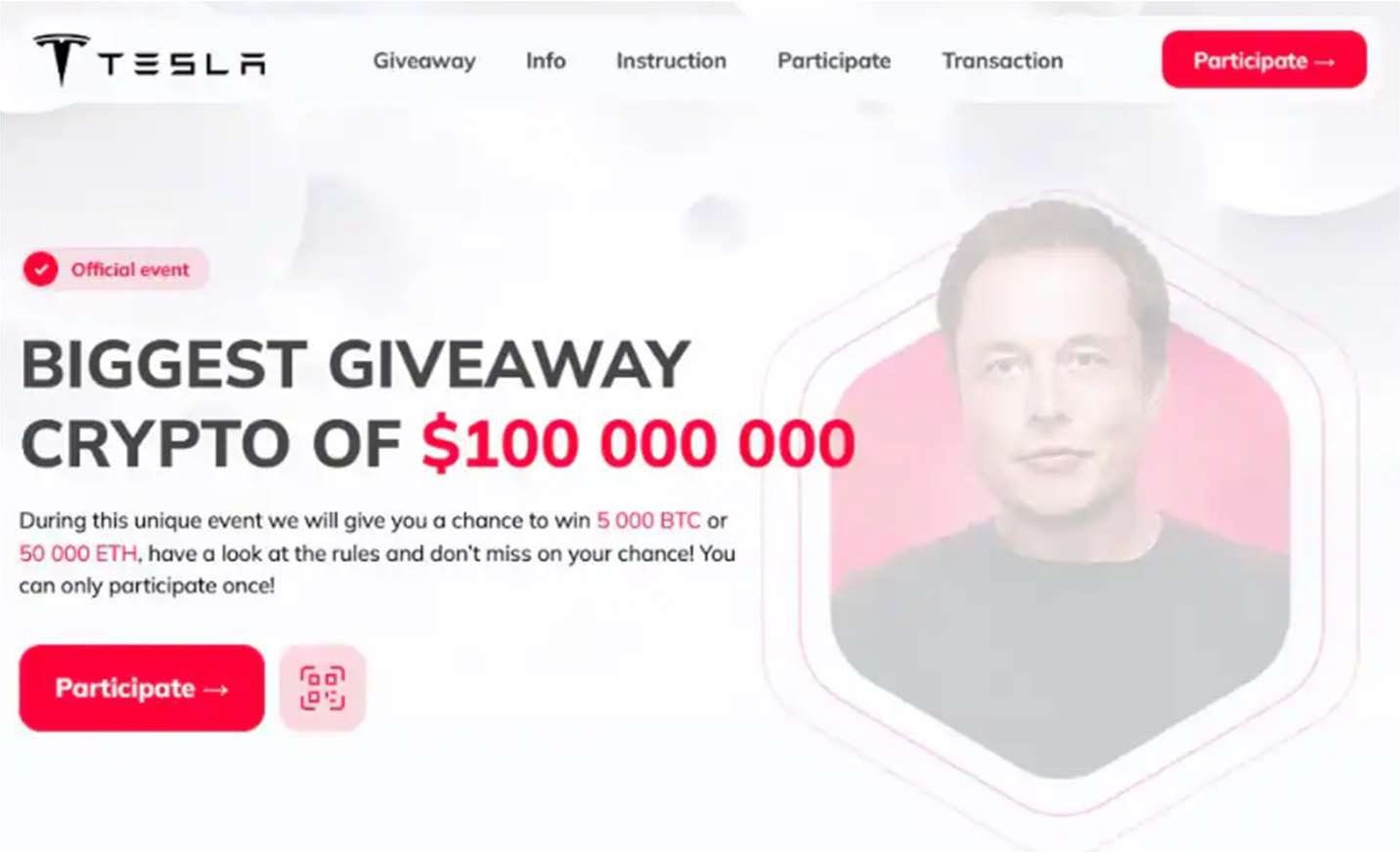
Lastly, scammers also still make use of email to lure victims — phishing emails attempt to convince the user that a crypto giveaway is being hosted, and clicking the link redirects them to the landing page of the scam details.
Case 2: Pump-and-Dump Scam
A pump-and-dump scheme is when insiders "pump" a coin or token — increasing its value significantly so that it creates a lot of attention and interest in the market. The moment others jump in, the initial investors "dump" (sell all their coins), causing a massive decrease in price and leaving late investors at a loss. Typically, a Telegram group is created where hype builds around a pump that will happen at a specific time. For a number of days, or around two weeks, marketing campaigns run and the group gets more excited as more participants join. The announcement will say, for example, that a pump will occur on a Sunday at 17:00 — without revealing which coin, usually a low market-cap coin — and members are told to expect 1000% growth so that "everyone will get rich."
The chart below shows a coin pumped and dumped over a three-hour span. As it illustrates, the pump had already started at 16:00, well before the 17:00 announcement time. At 17:00, the coin gets announced on the Telegram group and all participants jump onto an exchange to place a market buy order — but by then, most of the pump has already occurred. The chart continues slightly higher before the initial investors dump all their coins, causing the price to decrease rapidly. Some investors make modest profits if they sell in time, far short of the promised 1000%; others are already at a loss. The organisers then announce a "second wave" to keep hyped investors buying again — but the second wave never comes, leaving everyone dry. The initial organisers remain unknown, identified only by a Telegram name and group, making them almost impossible to catch. It should be noted that pump-and-dumps are illegal, and one should never participate in these events.

Case 3: Ponzi Scheme
Ponzi schemes are fraudulent investments where a platform is created for members to sign up and see their portfolios, each required to invite new members placed under them in a multi-level marketing (MLM) approach. High rates of return are promised, and do occur in the initial phases — similar to a pyramid scheme, where only the early investors benefit the most, since returns are only sustainable by bringing in new and more investors. The scheme makes investors believe that a cloud mining package, a successful trading bot, or some lending scheme is generating profits monthly, weekly, or even daily.
A well-known example is Mirror Trading International (MTI), an MLM scheme that claimed to offer automated crypto trading services via bots on behalf of its members, promising a consistent monthly return of 10% (in some cases 1% daily, depending on the member's level). The platform started operating in 2017 and made good returns for all members — until December 2020, when the website suddenly went down. False news spread that CEO Johann Steynberg had vanished and fled the country after receiving death threats, causing major panic: investors were unsure whether they had lost everything, while some members felt sorry for a CEO whose life was supposedly in danger.
Steynberg was arrested on 29 December 2021 for allegedly presenting fake identification to law enforcement, a year after fleeing the country. A trusted source with knowledge of the case reported that over 46,000 Bitcoin passed through the platform. He was believed to be under house arrest in Brazil, but the latest news was that Steynberg died on 22 April 2024 from a severe heart attack. A number of conspiracy theories are swirling and, at the time of writing, the matter continues to be investigated by South Africa's Directorate for Priority Crime Investigations (DPCI), also known as the Hawks.
Analysis of the Scams According to the Persuasion Principles
As for the vulnerabilities of the individuals caught in the scams, there were vulnerabilities on all three different levels of individual, social and situational. In addition, several persuasion principles were at use for each scam. Though all principles could be detected in every case to some degree, clear distinctions were found between what mattered most for each scam's credibility.
| Principle | Usage |
|---|---|
| Reciprocity | Somewhat utilised: in some cases with small-value coin giveaways, the scammer gives the victim double back straightaway, only to build trust so the victim deposits a larger amount — at which point the scammer disappears. |
| Consistency | Somewhat utilised: the scammer leans on crypto being new technology — if the victim is tech-savvy, or wants to be seen as such, crypto investments feel aligned with their self-image. |
| Social proof | Strongly utilised: chatbots on the YouTube live stream make it look like others are participating, making the victim more likely to follow. |
| Liking | Strongly utilised: many people like and follow Elon Musk. Building rapport and showing common ground increases the likelihood of successful persuasion. |
| Authority | Strongly utilised: the scammer impersonates a celebrity or influencer, borrowing their expertise and trustworthy reputation as leverage. |
| Scarcity | Strongly utilised: creating urgency to act now or lose out taps into fear of missing out, driving immediate action. |
As Table 1 shows, the giveaway scam is built strongest on the principles of scarcity, authority, liking and social proof. The vulnerabilities here were mostly on the individual and societal level, with the most valuable mechanism being the apparent social connections and trust on which victims learn to rely. Consistency and reciprocity serve merely a supporting role for this type of scam.
| Principle | Usage |
|---|---|
| Reciprocity | Somewhat utilised: a false promise of very high returns — some investors do make good returns, which encourages them to enter the next scheme if they believe they know the timing. |
| Consistency | Somewhat utilised: the same technique is used over and over for months; even members who lost big amounts believe next time will be their time. |
| Social proof | Strongly utilised: chatbots on the Telegram group make it look like others are participating in the pump. |
| Liking | Somewhat utilised: the only "liking" at play is the crypto community itself — a strong community of believers takes part. |
| Authority | Not utilised: no impersonation of a celebrity or influencer is typically used in this type of scam. |
| Scarcity | Strongly utilised: urgency to act now or lose out on a one-time opportunity drives immediate action. |
Pump-and-dump scams operate differently, relying most heavily on social proof and scarcity. Authority is not utilised at all, and reciprocity, consistency and liking are only somewhat utilised. Vulnerability levels were particularly evident on the social and situational levels, as social proof and scarcity arise in specific social and situational contexts, while individual vulnerabilities are exploited through how personal attributes influence a person's ability to comprehend or respond to information.
| Principle | Usage |
|---|---|
| Reciprocity | Strongly utilised: the platform generated good returns as promised from 2017; members could withdraw returns for three years, until December 2020. |
| Consistency | Strongly utilised: the scammers leaned on crypto and trading bots as cutting-edge technology, letting tech-unfamiliar users feel tech-savvy by investing — though users never actually owned any crypto, it was false dashboard data. |
| Social proof | Strongly utilised: marketing videos made it look like hundreds of members were joining live, and certain early-investor members were showcased as riches examples — returns late investors would never match. |
| Liking | Somewhat utilised: no famous person was used, but marketing made founder Johann Steynberg sound like a clever genius who had beaten the market with his own trading bots — members liked and believed in him. |
| Authority | Somewhat utilised: Steynberg was positioned as an overnight authority figure — if he believed the market was good, members believed it too. |
| Scarcity | Strongly utilised: the earlier a member invested, the better their chances of becoming financially free — MTI was framed as the only platform to have figured out the trading bot. |
Unlike the previous scams, the MTI Ponzi scheme builds strongly on reciprocity and consistency, together with scarcity and social proof. In terms of vulnerabilities, this means building on individual and cognitive vulnerabilities, as well as social vulnerabilities, by exploiting manipulative narratives and relationships between participants.
| Persuasion Principle | Crypto Giveaway Scam | Pump-and-Dump Scam | Crypto Ponzi Scheme |
|---|---|---|---|
| Reciprocity | Somewhat utilised | Somewhat utilised | Strongly utilised |
| Consistency | Somewhat utilised | Somewhat utilised | Strongly utilised |
| Social proof | Strongly utilised | Strongly utilised | Strongly utilised |
| Liking | Strongly utilised | Somewhat utilised | Somewhat utilised |
| Authority | Strongly utilised | Not utilised | Somewhat utilised |
| Scarcity | Strongly utilised | Strongly utilised | Strongly utilised |
Interestingly, all three cases relied heavily on social proof and scarcity, making understanding their underlying logic important when attempting to understand these scams — though each type of scam relies on a different combination of strategies beyond those two.
Conclusion
Recent studies suggest that individual and societal vulnerabilities play an increasingly larger role in the spread of misinformation and the successful execution of online scams. Understanding these vulnerabilities becomes especially important as AI improves the impact of deepfakes and new technologies enable the easier spread of manipulated information. This paper detected different influence strategies at use across the specific crypto scams analysed, ranging from authority figures in crypto giveaways, to the role of consistency and social proof in Ponzi schemes, to the scarcity principle behind pump-and-dump scams.
Comments (0)